
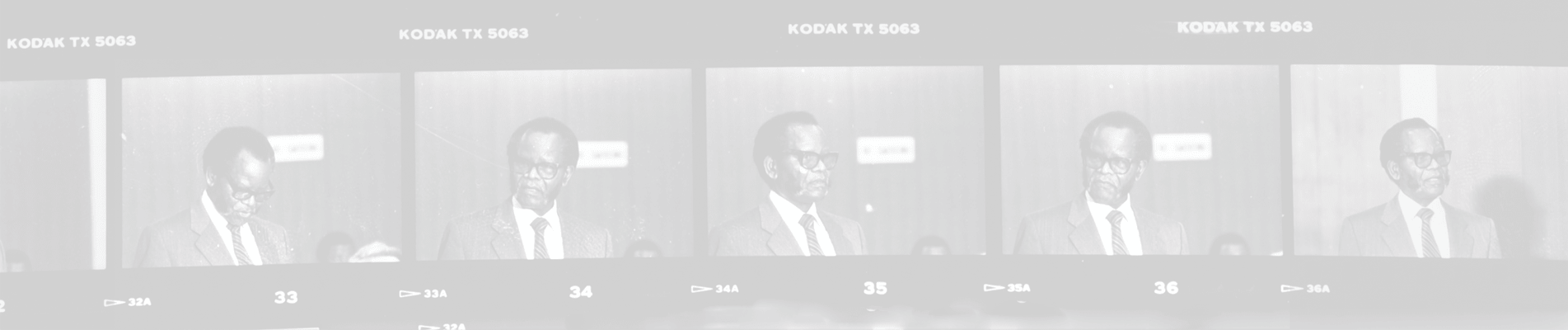

25 May Statement by Oliver Tambo on behalf of the National Liberation Movements
Statement by Oliver Tambo on behalf of the National Liberation Movements, at the special meeting on Africa Liberation Day during the International Conference On Sanctions Against South Africa
There can be no peace or stability in Southern Africa without the destruction of Apartheid
25 May 1981, Unesco House, Paris
On behalf of the national movements of Namibia and South Africa, I greet this distinguished gathering which has come together to celebrate Africa Liberation Day.
We welcome particularly the presence among us of the first Foreign Minister of the new France.
This is perhaps the first occasion on which a French Government has chosen to associate itself in this way with the aspirations of the African people. That the Foreign Minister should have made this his first official engagement augurs well for the prime objective of the Organisation of African Unity – namely, the liberation of the entire continent of Africa.
We in Africa express appreciation for the solidarity and support of the peoples in the rest of the world, of the members of the Non-Aligned Movement, the governments in other continents, and in particular the solidarity of all participants in the struggle for national liberation.
We salute the Socialist countries, which from the outset have firmly and consistently supported the anti-colonial and national liberation struggle in Africa.
Africa Liberation Day is a day of great significance. It is the day on which we celebrate the victories of the liberation struggle, the advance of free Africa to the borders of the Limpopo, leaving racism, exploitation and repression isolated in their laager in southern Africa.
But even as we celebrate this day, we must reiterate some of the tasks that still confront the African people. Our first task remains that of ridding our continent of the scourge of racism and colonialism. Secondly, we must liquidate the source of war in Africa. Thirdly, we must liquidate the base that imperialism has moulded at the southern tip of the African continent from which it now seeks to reverse the gains of the African revolution. Central to the successful completion of all these tasks is the removal of the illegal occupier of Namibia, the overthrow of the apartheid system and the transfer of power to the peoples of Namibia and South Africa. For it is the regime in Pretoria that is the last vestige of colonialism and racism in Africa. It is the Pretoria regime that is the source of war in Africa and is a threat to international peace and security. It is the Pretoria regime that is the agent of reaction and imperialism.
Therefore, in marking this day, we as liberation movements renew our pledge to be the vanguard forces and commit ourselves to complete Africa`s first task by liberating our countries and, in doing so, to take the necessary steps forward to liberate the entire continent of Africa.
The successful result of our liberation struggle is therefore of crucial importance to all African peoples, as it has been so recognised by the Organisation of African Unity, the Non-Aligned Movement and the majority of the nations of the world.
The importance and significance of the struggle against apartheid, and the centrality of this issue in international politics is reflected in the time and attention given by the international community to finding a solution to this problem. The convocation of this meeting today is further proof of its significance.
We meet here on the initiative of the United Nations and the Organisation of African Unity, as part of a gathering of nations and peoples of the world, to focus our attention on international action to eliminate from Africa and the rest of the world the most brutal and racist system of apartheid – a crime against humanity.
It is fitting that on this particular occasion, the national liberation movements acknowledge and pay tribute to the OAU and its member countries for the resolute determination with which they have sought to redeem their pledge made at the inception of the OAU to liberate the entire continent of Africa.
Let there be no doubt. The Governments and peoples of independent Africa have made tremendous sacrifice. Their economies have suffered; their development handicapped, in some measure at least, because of the need to allocate resources to the liberation of the entire continent.
We pay a particular tribute in this regard to the Frontline States and the countries neighbouring South Africa and Namibia. They have made enormous sacrifices and continue to do so in the series of wars that have had to be fought in the region. First there was the struggle of the peoples of Angola and Mozambique against the Portuguese colonialists. Before its successful conclusion, the struggle of the Zimbabwe people had begun to escalate. The victory of the people of Zimbabwe has given further momentum to the continuing struggle of the peoples of Namibia and South Africa against the Pretoria regime.
Every country in southern Africa, whether it achieved independence even before the formation of the OAU, or one year ago as did Zimbabwe, every country has experienced at first hand the inescapable truth that no country`s independence can be complete or secure until the whole of Africa is free. The summit meeting of the Non-Aligned Countries declared that there can be no peace or stability in southern Africa without the destruction of apartheid. Every country in the region has been the victim of unprovoked aggression. Their territorial integrity has been violated; their economies destabilised, their people murdered, their villages burnt, their economic infrastructure bombed and sabotaged.
The attacks begun by the Portuguese colonialists and continued by the Smith regime have been dramatically escalated by Pretoria which has not hesitated to invade an independent African State.
Despite this, these countries have remained resolute in their support for the liberation movements. They have supported the liberation struggle not only in pursuance of their national policy, but also as loyal members of the OAU, implementing a policy arrived at collectively by Africa.
In the period ahead of us, one of Africa`s most bitter struggles remains to be fought through to its inevitable victory. In dislodging the Pretoria regime and achieving total liberation, Africa will face one of its greatest tests. The enemy we confront is not just the apartheid regime, but international imperialism which has for so long sought to protect its South African base.
With the advent of the Reagan Administration, we are now faced with a major effort to roll back the tide of liberation in Africa. Africa needs to defend its independence and to assert its sovereign right to determine its own policies and priorities. The United States Administration behaves as if the whole continent of Africa were but a pawn, and tries to assert the paramountcy of United States interests in Africa, the Indian Ocean and the South Atlantic.
We in Africa must reject this policy and reassert our goals. We must affirm the legitimacy of the liberation struggle and the sovereign right of every independent State to seek and obtain assistance from other States to protect its territorial integrity and political independence.
In conclusion, we would like to convey the greetings and congratulations of the liberation movement to the brother peoples of Africa on the occasion of Africa Liberation Day. In saluting the world forces of progress that are celebrating with us here today, we would like to reiterate our pledge:
Drawing strength from the support you have and are continuing to render to us, the peoples of Namibia and South Africa, shall intensify the struggle for the overthrow of the apartheid regime, the liquidation of racism and colonialism in our region and the transfer of power to the hands of the anti-fascist, democratic and peace-loving peoples of Namibia and South Africa.